Kuwait’s catering sector has established itself as a key revenue contributor within the hospitality and foodservice industry.
From social celebrations to corporate functions, the catering scene is flourishing through diverse operational models. With insights from industry experts, we explore how the sector is evolving. Additionally, we spotlight the varied approaches business leaders are adopting in this buoyant market.
Tapping into tradition
Catering for large-scale social events has become a cornerstone of food and beverage revenue in Kuwait.
“In Kuwait culture, people really like to make events and parties,” noted Wissam Hmeidan, general manager of Elio Catering.
Significantly, both on-site and off-site operations are fueling growth. Functions proving popular range from weddings and corporate events to institutional gatherings. In turn, operators have expanded their capabilities to meet this increased demand.
Notably, for hoteliers, these events are translating into significant revenue impact. Catering now represents 60 percent of F&B revenue, compared to 40 percent from restaurants, highlighting its financial importance. Here, success relies on three pillars, according to key operators, namely: people, culinary diversity and logistics.
Thierry Foehrenbach, director of operations at Crowne Plaza Kuwait–Al Thuraya City, explained this reasoning. “Strong sales, culinary and operations teams, combined with seamless service delivery, are essential to maintaining trust in a market that has been established for decades,” he noted.
Market capacity and business models
Critically, despite Kuwait’s relatively small size, business leaders agree that the catering market is far from saturated. Indeed, there is recognition that competition plays a positive role by pushing innovation in presentation, service and experience design.
“There is space for everyone,” said Roland Sayah, general manager of Dar Hamad.
Scale and size vary significantly, depending on the models operators adopt and the venues offered. For example, hotels are often able to utilize ballrooms, conference rooms and extensive infrastructure. As a result, they can serve large numbers of guests, ranging from hundreds to several thousand, in-house and outside. Meanwhile, independent caterers tend to focus on flexibility and customization, working at scales suited to more personalized service. Consequently, pricing strategies differ accordingly. However, demand for premium offerings remains strong across segments.
Differentiation through positioning
Rooted in tradition and heritage, regional cuisine enjoys widespread popularity among Kuwaiti diners. Accordingly, several restaurant-led operators have found success translating their dine-in identity into off-site catering while maintaining this culinary focus.
Standalone specialists, meanwhile, are offering fully integrated models delivering end-to-end solutions, from food and service to decor and logistics. Leveraging their strengths, hotels combine culinary diversity with extensive event infrastructure.
Additionally, some industry leaders are anchoring their approach in craftsmanship and personalization to create memorable experiences. “We don’t serve food—we serve memories,” said Thierry Papillier, executive chef at Four Seasons Hotel Kuwait at Burj Alshaya.
Technology supporting efficiency
Understandably, operators remain cautious about artificial intelligence in culinary creativity. However, there is broad consensus on its value in operations. From inventory management to event routing and guest preference tracking, technology is increasingly supporting efficiency behind the scenes. “We are using it to have five events in one day,” Hmeidan noted.
Beyond digital tools, sustainability efforts are also gaining traction. For example, reducing plastic use, sourcing responsibly and managing waste are priorities, driven by supplier initiatives and client awareness.
Operational challenges
Undoubtedly, talent acquisition and retention represent the sector’s biggest challenge. Industry leaders point to staffing costs, training and motivation as key hurdles. “You need to attract talent. That’s sometimes complicated,” Foehrenbach admitted.
Crucially, industry collaboration on staffing has emerged as one response to recruitment pressures.
Elsewhere, seasonal fluctuations present additional challenges. Other hurdles include operational costs and complex logistics. Tellingly, these can be particularly acute for hotel-based teams managing both in-house banqueting and external functions simultaneously.
Expansion ahead
Despite these pressures, industry leaders remain confident in Kuwait’s position as a regional F&B hub. Importantly, optimism is reflected in their ambitious plans, which range from new hotel openings and concept diversification. Overall, the sector’s resilience and demand for services reflect how deeply catering is woven into Kuwait’s social fabric.
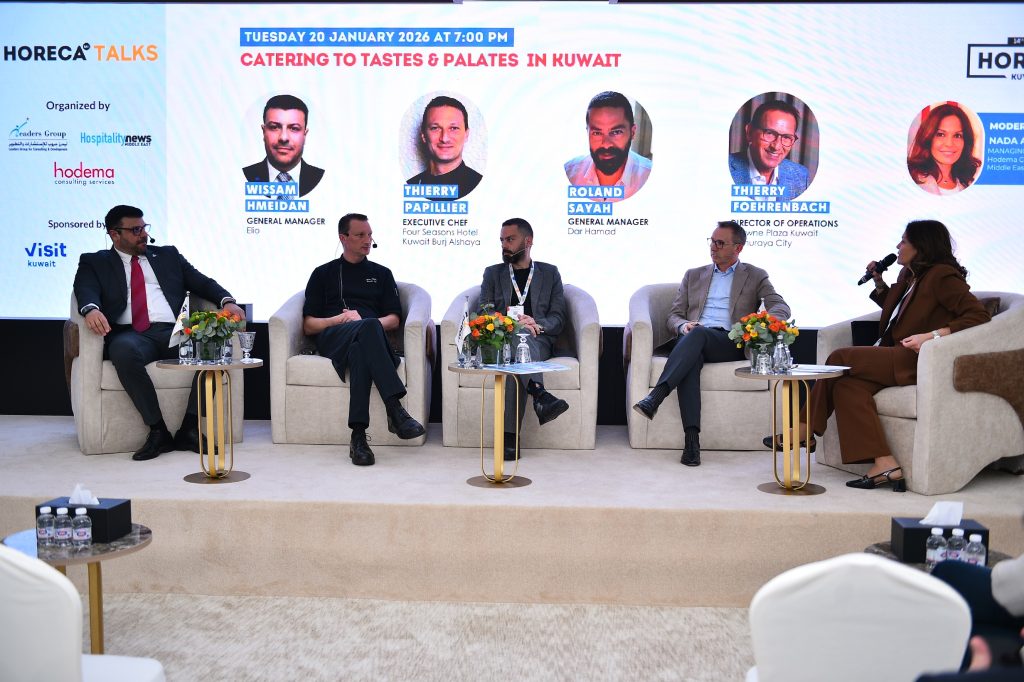
Insights from HORECA Talks at HORECA Kuwait 2026, co-organized by Hospitality News Middle East and Hodema Consulting Services. Session moderated by Nada Alameddine, managing partner at Hodema Consulting Services, Middle East & Africa.