The end of minimalism as the default
Minimalism no longer holds the authority it once commanded, as hospitality design increasingly moves toward richer and more expressive spatial identities. Across the region, spaces defined purely by restraint face growing competition from interiors embracing visual density while preserving composure. Rather than seeking calm alone, guests increasingly gravitate toward environments that stimulate emotion while still offering comfort and spatial reassurance. Consequently, designers now question not simplification or intensity alone, but how both can coexist harmoniously within a unified spatial framework.
Hybrid aesthetics as spatial strategy
Increasingly, the fusion of maximalist and minimalist sensibilities functions as a considered strategy rather than a passing stylistic experiment. Expressive elements like vibrant prints, metallic accents and abstract murals integrate carefully within interiors grounded by lighting, clarity and spatial logic. As a result, spaces achieve layered richness without visual chaos, maintaining operational efficiency while offering memorable and emotionally engaging environments.
Materiality as the balancing mechanism
Often, materials assume responsibility for mediating tension between expressive intensity and disciplined restraint within contemporary hospitality interiors. Rich timbers, textured surfaces and sculptural installations introduce depth, while neutral backdrops and controlled lighting stabilize overall composition. Furthermore, jewel tones punctuate spaces rather than dominate. Consequently, they create visual rhythm without overwhelming the guest experience emotionally. Moreover, the objective remains equilibrium, prioritizing balance and coherence over contrast pursued purely for visual or conceptual impact.
Design case reference: MEI Jumeirah Mina ASalam
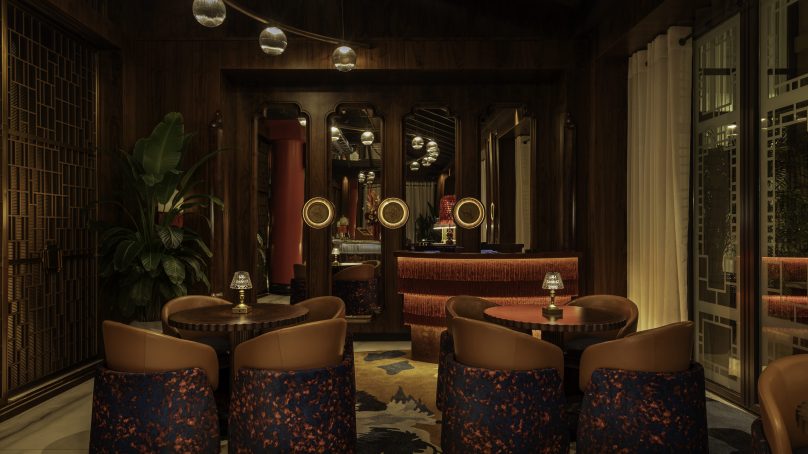
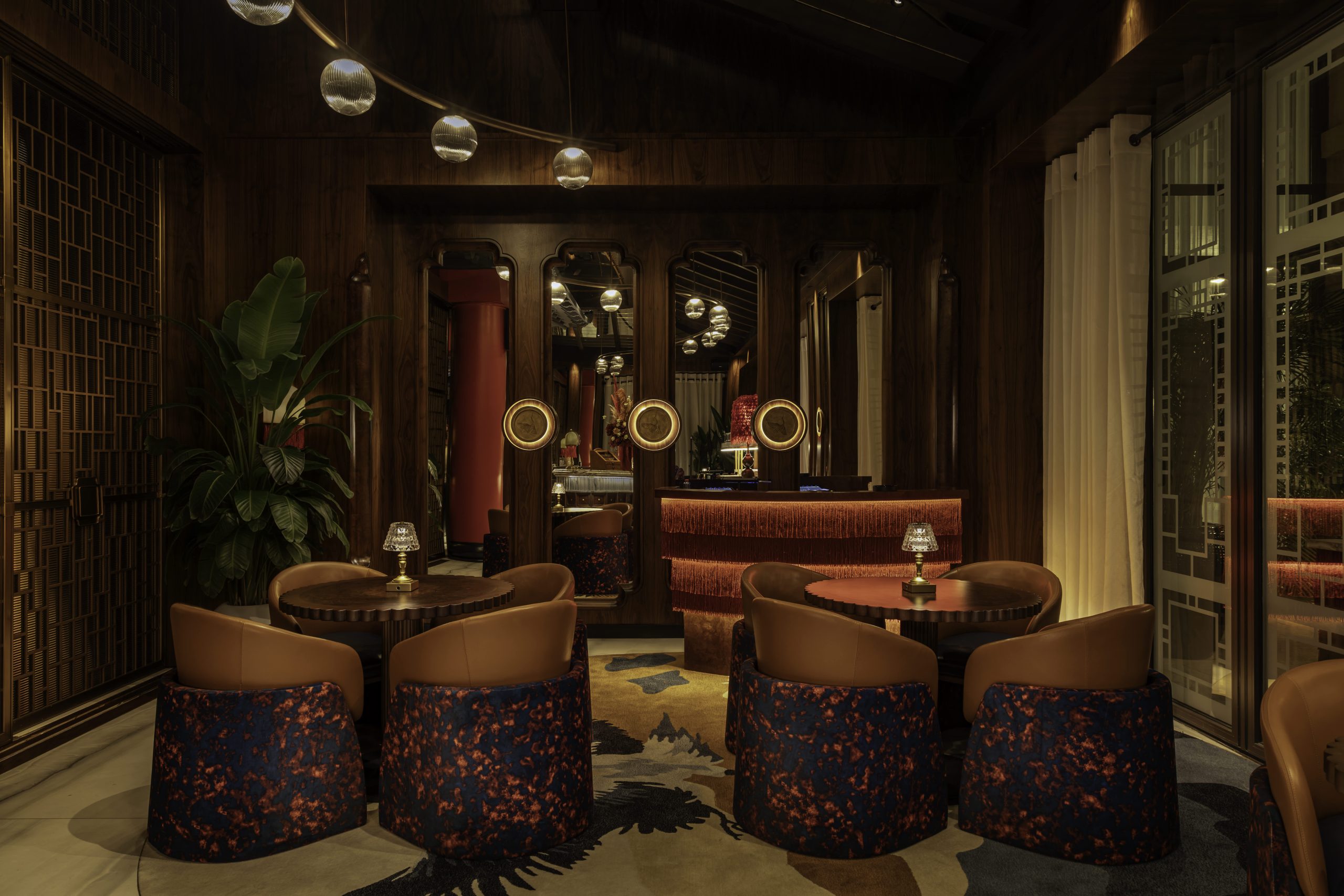
A clear example of this balance appears at MEI, where layered visual language coexists seamlessly with spatial composure. Furthermore, the interior incorporates crane murals, patterned textiles, sculptural lighting and metallic accents within a framework defined by proportion. Moreover, warm materials like walnut, burl wood and backlit onyx anchor expressive gestures. Thus, the result is cohesion rather than isolated decorative statements. Consequently, the space oscillates between intensity and calm, illustrating how magical maximalism can coexist comfortably with quiet luxury.
Atmosphere over ornament
Within this hybrid model, atmosphere increasingly replaces ornaments as the primary carrier of emotional meaning and spatial identity. Light, tactility and proportion shape perception more powerfully than decorative layering alone, guiding comfort, mood and intuitive spatial navigation. Furthermore, subtle sculptural features and tactile textiles introduce depth and movement while preserving clarity, comfort and visual legibility throughout interiors.
Operational realities and spatial flexibility
Hospitality environments must function as adaptable systems responding efficiently to varied guest behaviors and commercial requirements. Therefore, expressive yet restrained interiors support multiple uses through modular layouts, adaptable lighting and finishes designed for durability. As a result, hybrid aesthetics address guest expectations while simultaneously aligning with operational demands and long-term functional performance.
Toward a more nuanced hospitality language
The convergence of expressive richness and disciplined restraint signals a broader evolution in hospitality spatial thinking. Rather than choosing spectacle or serenity, designers increasingly create environments capable of holding both experiences simultaneously. Projects like MEI demonstrate how visual richness and relaxed elegance can coexist, offering emotionally engaging yet operationally grounded interiors.
Firas Alsahin,
Co-founder and creative director at 4SPACE
@4spacedesign
@firas.alsahin
.linkedin.com/in/firas-alsahin