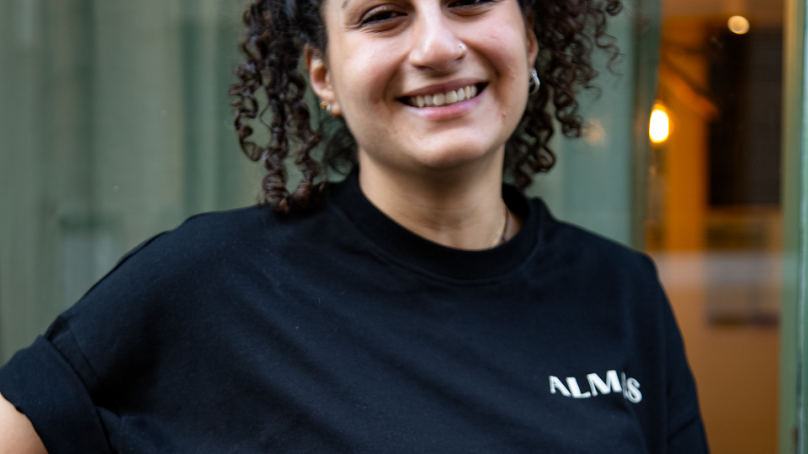
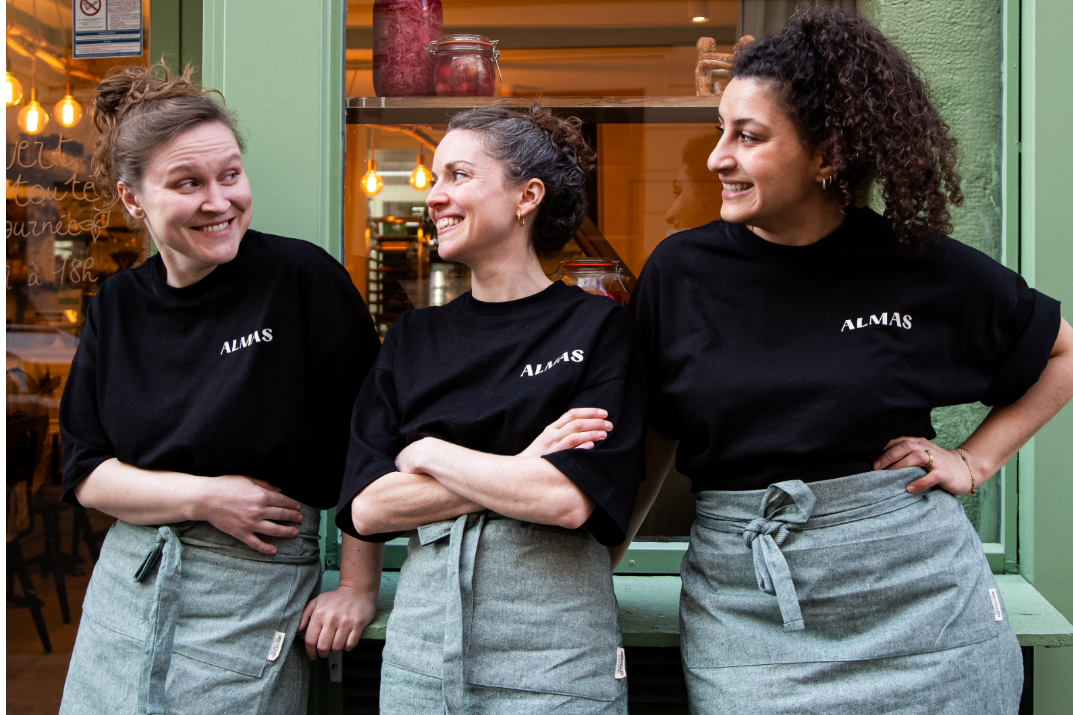
Sandra Sfeir took an unconventional path to the kitchen. After earning a degree in graphic design, she moved to Paris to train in French cuisine. She once intended to return to Lebanon to manage her father’s restaurant but chose instead to build something of her own in Paris. At Almas, friendship became as central as heritage, shaping a concept rooted in shared memories and collective storytelling. She tells us more.
Why did a Russian street pastry feel like the right canvas for telling your story?
It’s not a Lebanese, Russian or Iranian story. Rather, it’s about a friendship, an ethical and, more importantly, a heritage story. With the world changing so much, we wanted to honor our families’ cuisine and recipes. The Eastern Pirojki Anna grew up with made Maryam and me feel like we were in a cocoon. They’re so fluffy and soft, especially with our countries’ flavors and aromas as fillings.
Almas is built on childhood recipes. How did memory shape the menu?
There is technique in the sense that we are limited to simmering and roasting in our kitchen. So, we had to come up with ideas to adapt some recipes, like stuffed eggplants or rolled cabbage mehshe malfouf. Moreover, technique is needed to get the results we want. This involves finding the perfect combination of flavors and level of moisture to reach an ideal filling. Furthermore, to be able to honor our families’ recipes, we each dug thoroughly into different relatives’ specialties. We did the best we could despite the limited information, no measurements and absolutely no instructions. So, we relied on our own techniques and creativity to honor them in our way.
Paris is crowded with concepts chasing authenticity. What sets yours apart?
You said it yourself: chasing authenticity. We are not interested in concepts or in serving food that follows trends. Our focus is simple and personal. Furthermore, we cook homemade cuisine, prepared with care and intention, as a way to stay true to who we are and to honor our families. Moreover, authenticity for us is not a marketing angle. It lives in our welcome, in the atmosphere and in every flavor that reaches the plate.
Cooking with Anna and Maryam is central to the project. How did friendship influence your decision to open this concept?
The three of us have a love and hate relationship with our respective countries. When we were cooking together at Alessandra Montagne’s restaurant Nosso, we were sharing homemade recipes from our cultures. So, the canvas was friendship and heritage. In our three gastronomic heritages, we have a kind of stuffed bread. After a lot of trials, we realized the Pirojki was the perfect form. It is an eastern street food resembling the Lebanese mouajanet but much fluffier. Thus, it was the perfect form for an adaptation of our families’ cuisine.