
Since the franchising business began to flourish globally, the Middle East has served as a real-world testing lab for many international brands. The first entrants were well-known fast-food names such as McDonald’s and KFC, selling the American dream to local diners.
Their moves proved to be a one-way ticket to success. As a result, these brands, joined by many others, are now a familiar presence in Arab cities. Most operate in malls and busy food courts, offering the same lucrative concepts that proved so effective in the United States.
The fast-food takeover
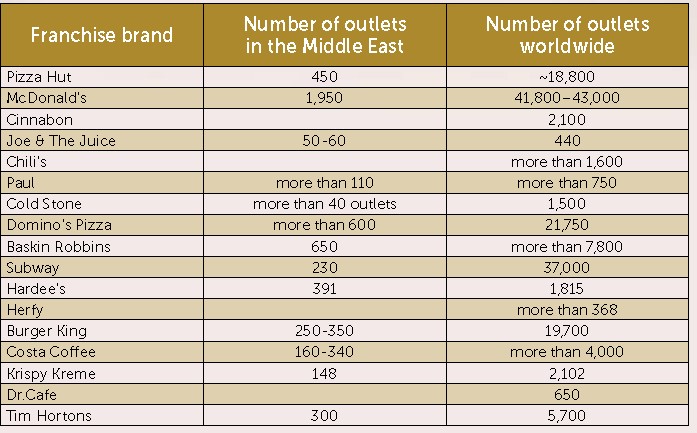
McDonald’s currently operates around 1,950 outlets in the Middle East and GCC—far fewer than its global network of nearly 42,000 branches. Yet it dominated the regional franchise import scene for years. Starbucks has since caught up, expanding rapidly to reach roughly 2,000 stores across the region.
Fast-food outlets of all kinds, from burger joints to pizza parlors and coffee shops, have now become part of everyday eating patterns. Consumers were already familiar with quick meals and takeaway culture, thanks to local favorites such as shawarma, falafel, manakish and saj. Buying coffee to go has long been a local tradition as well, which helped Western coffee chains blend easily into the market.
Unpacking the concepts
Franchises can generally be divided into three categories: fast food, casual dining (including pizza and coffee shops) and single item offerings. The first category counts major players such as Subway, KFC, Hardee’s and Burger King— all firmly rooted across the Gulf, where a multicultural population has embraced Western style takeaways. Pizzas represent one of the mainstays of the casual segment, with brands such as Pizza Hut, Domino’s, Little Caesars Pizza, Pizza Express and Papa John’s competing for customers. Pizza Hut and Domino’s continue to lead the category.
Global casual concepts like P.F. Chang’s, Chipotle and Chili’s have also become household names. Meanwhile, coffee shop franchises, such as Costa Coffee, Tim Horton’s, Starbucks, Cinnabon and Joe
& The Juice, thrive alongside the region’s coffee shop culture. French bakery “Paul” turned into a restaurant and found equal success as a casual dining option. Likewise, single item dessert chains such as Baskin Robbins, Cold Stone and Krispy Kreme have become local fixtures.
Big business if done right
As international brands thrived thanks to Middle Eastern customers, local investors and entrepreneurs who took the franchising leap also reaped major rewards. A handful of large operators now dominate the regional scene across F&B, hospitality, fashion, health, beauty and leisure.
Kuwait-based Alshaya Group manages nearly 60 international brands, including Starbucks. Its food portfolio also features P.F. Chang’s, Pinkberry, Pizza Express, Chipotle and Shake Shack. Americana, another Kuwaiti powerhouse, operates major fast food concepts such as Hardee’s, KFC, TGI Fridays, Wimpy and Pizza Hut. In Lebanon, Azadea grew from a small family run clothing store in 1978 into a group managing brands like Paul and Eataly.
Saudi Arabia’s BAAN Holding Group, formerly Al Hokair, has carved out a niche in hospitality, running franchises for hotel giants such as IHG, Radisson, Accor, Hilton and Golden Tulip. Altogether, it manages 22 hotels with more than 2,700 keys.
Outward expansion
After years of thriving on imported concepts, regional developers—many of them Lebanese—began turning the tables. They restructured their homegrown businesses to be franchise ready, creating opportunities for new franchisees across Arab and international markets.
To stand out, these entrepreneurs leaned into authenticity. Lebanese brand Em Sherif is one of the best-known success stories, with 37 outlets spanning restaurants, cafes, seaside venues and delis in the Middle East, Monaco, Ivory Coast, Madrid, Paris and London. Additionally, they will soon enter China and Hong Kong. Other Lebanese names such as Abd El Wahab, Al Falamanki, Bebabel and chicken specialists Ahmad Al Abdalla and Al Abdalla have expanded across the Gulf and Europe.
Global contenders
Regional franchisors are no longer limiting themselves to traditional or oriental cuisine. Several are competing head on with global players. Saudi-born Herfy, for instance, has become a national fast food champion, with almost 370 outlets across the kingdom, Kuwait, Bahrain and the UAE. Kudu follows closely, with more than 300 outlets, though both remain smaller than the American heavyweights.
In the casual dining segment, chains such as Zaatar W Zeit and Casper & Gambini’s have successfully expanded through local franchisees across the Middle East and Africa.
For decades, the region embraced international franchises with open arms, eager to experience the latest trends. Yet today, as the market matures and competition intensifies, local brands are emerging as strong contenders, ready not just to import but also to export the next wave of global franchise concepts.

Nagi Morkos
Founder and Managing Partner
Hodema
Hodema.net ; Fb/hodemaco
@nagimorkos ; @hodema
FRANCHISE OUTLET NUMBERS: MIDDLE EAST VS. WORLDWIDE